1. Project Background: Addressing the Complexities of Breakbulk and General Cargo Terminals
While container terminals benefit from highly standardized processes, operating breakbulk and general cargo terminals presents significantly greater challenges. Cargo comes in varying shapes, sizes, and specifications, while complex loading and unloading processes require close coordination across multiple types of handling equipment and transportation resources.
The GTOS (General Terminal Operating System) project was designed to address these challenges by providing a specialized digital solution for managing port and depot operations. The system enables large-scale terminals to digitize and optimize their operational processes, with Tan Thuan Port serving as a representative deployment project.
2. Advanced Operational Planning
The core strength of GTOS lies in its comprehensive Operation Planning module. The system provides planners with a centralized set of digital tools to organize and optimize operational activities before a vessel even arrives at the terminal.
Berth Planning & Vessel Definition
Optimizes berth allocation for vessels and barges, helping minimize waiting times and improve overall berth utilization.
Yard Planning
Strategically plans storage areas for bulk and general cargo to maximize yard capacity and prevent localized congestion.
Equipment & Resource Planning
Allocates and coordinates operational resources — including quay cranes, trucks, forklifts, and other handling equipment — for each working shift across import, export, and cargo relocation operations.
3. Visual Vessel Itinerary Management
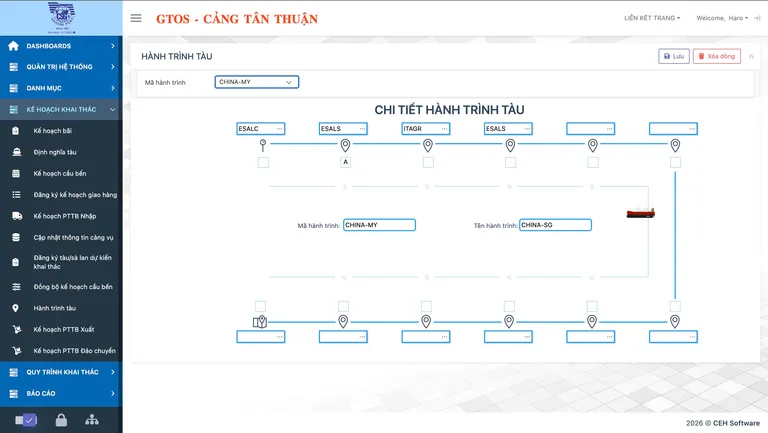
One of the standout features of GTOS is its ability to manage and monitor vessel itineraries in a clear, intuitive manner.
Intelligent Itinerary Visualization
Instead of relying on complex Excel spreadsheets to manage vessel schedules, GTOS provides a linear routing interface that allows operators to visualize and manage vessel journeys more efficiently.
Detailed Route Management
Operators can define and monitor voyage codes such as CHINA-MY and CHINA-SG, while tracking intermediate ports and waypoints along the route, including locations such as ESALC, ESALS, and ITAGR.
ETA Monitoring
Accurate Estimated Time of Arrival (ETA) tracking enables terminal operators to proactively coordinate with port authorities and prepare resources and operational plans for immediate vessel handling upon arrival.
4. Integrated Port and Depot Operations
GTOS connects information flows across the entire operational process — from delivery plan registration and yard operations to port authority updates.
All operational data is centralized within a unified dashboard, providing greater visibility, consistency, and transparency throughout the entire cargo lifecycle at the terminal.
5. Results and Business Value
The implementation of GTOS transforms traditional, manual port operations into a centralized and digitally managed operating environment.
The solution helps breakbulk and general cargo terminals:
- Reduce vessel turnaround time
- Maximize berth and yard utilization
- Improve overall operational efficiency
At the same time, real-time reporting capabilities provide management with timely operational insights, enabling faster and more informed decision-making.
By combining operational planning, vessel itinerary management, yard coordination, equipment allocation, and real-time reporting within a single platform, GTOS contributes to the modernization and digital transformation of Vietnam's port industry, while enhancing the competitiveness of local terminals in the international market.
Keywords: GTOS, General Terminal Operating System, breakbulk terminal management, general cargo port operations, berth planning software, vessel itinerary management, yard planning system, Tan Thuan Port, port digital transformation