1. Background and Challenges in CFS Warehouses (Ports & Depots)
Managing a Container Freight Station (CFS) warehouse within ports and depots is one of the most operationally complex tasks in the logistics industry. The continuous, high-volume flow of Less-than-Container Load (LCL) cargo makes manual tracking methods — including paper records and Excel spreadsheets — increasingly inefficient and error-prone.
Without a digital system in place, warehouse operators often face several recurring challenges:
- Time-consuming cargo searches, as staff must manually locate shipments across large storage areas.
- Inefficient forklift movement, with overlapping routes and unnecessary travel between pickup and drop-off points.
- Documentation errors, particularly during Housebill-based cargo handling, which can lead to mismatched or misplaced shipments.
To solve these operational bottlenecks, the CFS Warehouse Management System was developed to deliver real-time data management and comprehensive digital control over every stage of warehouse operations — from cargo intake to final dispatch.
2. Visual Warehouse Space Management
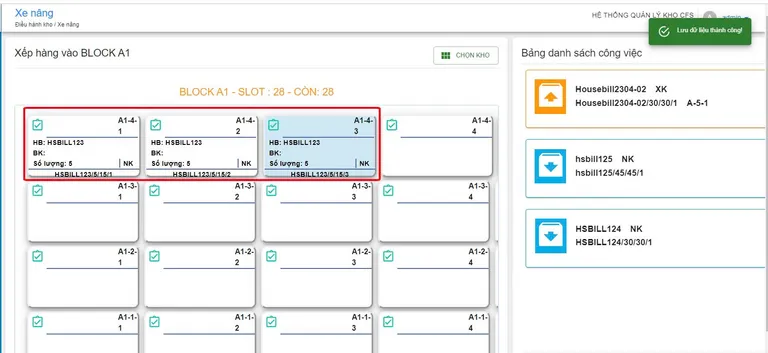
Rather than relying on static spreadsheets, the system digitizes the entire warehouse layout into an intuitive, interactive Grid Layout, giving operators precise control down to the individual storage slot.
Block & Slot Management
Supervisors can instantly monitor the status of any warehouse zone — for example, Block A1, Slot 28 — without needing to walk the floor or cross-reference multiple documents.
Detailed Slot Visibility
Each storage slot, such as A1-4-1 or A1-4-2, displays real-time details including:
- Current cargo occupancy
- The assigned Housebill (HB) number
- The corresponding cargo quantity
Slots currently being handled are highlighted with red borders, providing a clear visual warning that helps prevent incorrect cargo placement and reduces the risk of operational conflicts on the warehouse floor.
3. Real-Time Forklift and Task Management
At the core of the system is its real-time forklift task management module, which significantly improves operational speed and coordination across depot facilities.
Task List
- Inbound tasks (NK) are marked with a green arrow
- Outbound tasks (XK) are marked with an orange arrow
Tasks are automatically dispatched from the central system directly to mobile devices or tablets carried by forklift operators, eliminating delays caused by manual instruction or radio communication.
Detailed Task Instructions
Each dispatched task includes all essential information the operator needs:
- Housebill number
- Cargo quantity
- Exact pickup or drop-off location (e.g., Block A-5-1)
Real-Time Status Updates
Once a task is completed, the operator confirms it directly on the mobile device, instantly syncing the update with the central server. This allows operations managers to track cargo movements and overall warehouse activity in real time, without waiting for end-of-shift reports.
4. Strict Housebill Tracking and Cargo Loss Prevention
The system uses the Housebill (HB) as the primary identifier for tracking every cargo movement throughout the warehouse.
Whether handling export consolidation or import deconsolidation, every transaction — including movement, timestamp, and package quantity — is digitally recorded. This creates a complete, auditable digital footprint for each shipment, significantly reducing the risk of misplaced, mismatched, or lost LCL cargo within the CFS warehouse or depot.
5. Business Value for Logistics Operations
The CFS Warehouse Management System delivers measurable, practical benefits for ports, depots, and logistics companies:
BenefitImpact
Resource Optimization
Reduces unnecessary forklift travel and streamlines pickup/drop-off routing
End-to-End Data Visibility
Eliminates information delays between office documentation teams and on-site operations
Improved Operational Efficiency
Enables faster cargo handling, more accurate inventory positioning, and better team coordination
Enhanced Competitiveness
Supports high-speed cargo handling and helps meet the operational standards required by major shipping lines
By combining visual warehouse management, real-time forklift task dispatching, Housebill tracking, and centralized data synchronization, the CFS Warehouse Management System transforms traditional warehouse operations into a faster, more transparent, and fully digitally connected environment — helping ports and depots stay competitive in an increasingly demanding logistics landscape.
Keywords: CFS Warehouse Management System, Container Freight Station, LCL cargo management, warehouse digitization, real-time forklift task management, Housebill tracking, port and depot operations, warehouse grid layout