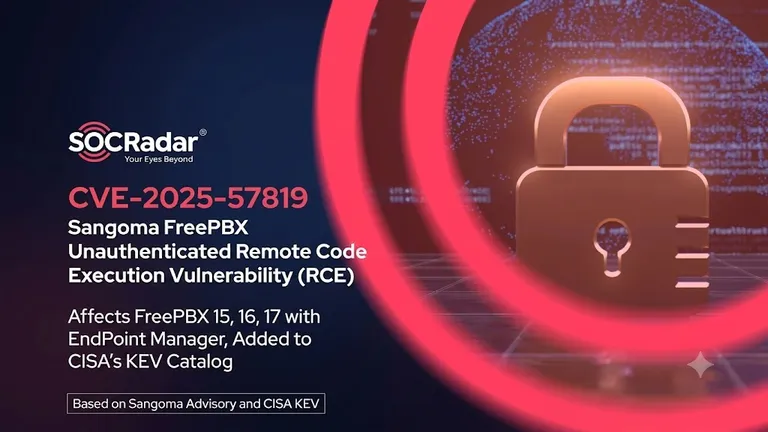
CVE-2025-57819 is a critical security vulnerability affecting FreePBX, a widely used open-source web-based graphical user interface (GUI) that manages Asterisk PBX systems for enterprise VoIP networks.
This vulnerability allows an unauthenticated remote attacker to bypass the FreePBX Administrator authentication mechanism. Subsequently, the attacker can execute unauthorized database operations, ultimately leading to **Remote Code Execution (RCE)** on the affected system.
According to the CVE record, this vulnerability is rated CVSS 4.0: 10.0 – Critical and involves two main weakness types: CWE-288 (Authentication Bypass) and CWE-89 (SQL Injection).
> Summary: If your FreePBX system is running an affected version and the administrative interface is accessible from the Internet, this vulnerability must be remediated immediately.
---
## What is CVE-2025-57819?
CVE-2025-57819 is a security flaw in FreePBX related to improper handling and validation of user-supplied input.
According to the vulnerability description, insufficient sanitization allows attackers to gain unauthorized access to the **FreePBX Administrator** panel without completing the standard authentication process.
From this entry point, the attacker can manipulate the database. Under the right conditions, this attack chain leads to full Remote Code Execution (RCE).
What makes this particularly devastating is that it's not just a standard SQL Injection. The combination of Authentication Bypass + SQL Injection + RCE elevates the impact of CVE-2025-57819 to a severe level.
---
## Quick Facts about CVE-2025-57819
| Information | Details |
| ------------------------- | -------------------------------------------- |
| CVE ID | CVE-2025-57819 |
| Product | FreePBX |
| Vendor | Sangoma / FreePBX |
| Severity | Critical |
| CVSS 4.0 | 10.0 |
| CVSS 3.1 | 9.8 |
| CWE | CWE-288, CWE-89 |
| Attack Vector | Network |
| Authentication | None required |
| User Interaction | None required |
| Impact | Confidentiality, Integrity, Availability |
| Status | Patch available |
Publicly disclosed in August 2025, the vulnerability currently affects FreePBX versions 15, 16, and 17 if left unpatched.
---
## Which FreePBX versions are affected?
The affected versions have been identified as follows:
| FreePBX Branch | Affected Versions | Patched Versions |
| -------------- | ----------------- | ---------------- |
| FreePBX 15 | `< 15.0.66` | 15.0.66+ |
| FreePBX 16 | `< 16.0.89` | 16.0.89+ |
| FreePBX 17 | `< 17.0.3` | 17.0.3+ |
Administrators should update immediately if their systems are running versions lower than the patched releases listed above.
---
## Why is CVE-2025-57819 so dangerous?
The true danger of CVE-2025-57819 lies in its ability to form a complete attack chain.
A high-level view of the exploit chain:
Internet → Authentication Bypass → FreePBX Administrator → SQL Injection → Database Manipulation → RCE
### 1. Authentication Bypass
Attackers can access administrative functions without valid credentials. This is exceptionally dangerous as systems cannot rely on strong admin passwords to prevent the attack.
### 2. SQL Injection
Once the authentication layer is bypassed, unsanitized inputs pave the way for unauthorized SQL queries, directly compromising data integrity.
### 3. Remote Code Execution
If exploitation is successful, the impact extends beyond the database, allowing the execution of arbitrary commands on the underlying server. Attackers can gain partial or complete control depending on the privileges of the FreePBX service.
---
## How can VoIP systems be affected?
FreePBX manages critical components of enterprise VoIP infrastructure. A compromised PBX system can result in severe consequences:
* Unwarranted modifications to PBX configurations, creating or altering extensions.
* Tampering with SIP configurations and call routing.
* Using the server as a pivot point for lateral movement (attacking other internal systems).
* Deploying malware, ransomware, or persistent backdoors.
* VoIP service disruption, toll fraud (unauthorized outbound calls), and massive telecom billing anomalies.
For enterprises, a compromised FreePBX server is not just a telecom issue; it's a gateway into the corporate internal network.
---
## Has it been exploited in the wild?
Yes.
CVE-2025-57819 has been added to the CISA Known Exploited Vulnerabilities (KEV) Catalog, confirming active exploitation in the wild.
Organizations must not ignore this threat. If you are running an affected version with an internet-facing management interface, treat it as an active security incident risk, not just a routine patch.
---
## Mitigation and Remediation
### 1. Prioritize FreePBX Updates
The primary fix is to upgrade FreePBX to the patched versions:
* FreePBX 15 → 15.0.66 or newer
* FreePBX 16 → 16.0.89 or newer
* FreePBX 17 → 17.0.3 or newer
(Note: Always perform a full backup and verify system compatibility before upgrading a production environment).*
### 2. Restrict Internet Access to the Administrator Panel
Reduce your attack surface immediately by restricting access to the FreePBX management interface. It should only be accessible via a secure VPN or internal LAN, never exposed publicly to the Internet.
### 3. Review Logs Post-Update
Applying the patch does not mean your system hasn't already been compromised. Administrators must proactively hunt for indicators of compromise (IoCs):
* Inspect Web access and Authentication logs.
* Monitor database activity and unusual changes in SIP settings.
* Check for newly created admin accounts, rogue extensions, strange cron jobs, or unknown processes.
If signs of compromise are found, initiate a full incident response procedure rather than simply applying the patch.
---
## Quick Administrator Checklist
- [ ] Identify the current FreePBX version.
- [ ] Backup configurations and the database.
- [ ] Upgrade FreePBX to the patched version.
- [ ] Restrict FreePBX Administrator access from the public Internet (Configure Firewall/VPN).
- [ ] Audit access logs, authentication logs, and hunt for anomalous processes/files.
- [ ] Enhance monitoring and log this CVE in your vulnerability management system.
> Security Takeaway: CVE-2025-57819 demonstrates that updating software is not enough. A robust security posture requires defense-in-depth (Firewalls, Reverse Proxies, Monitoring) to isolate and contain threats if one layer is breached.
---
References: CISA KEV Catalog, FreePBX Security Advisory, Check Point Security Advisory.